


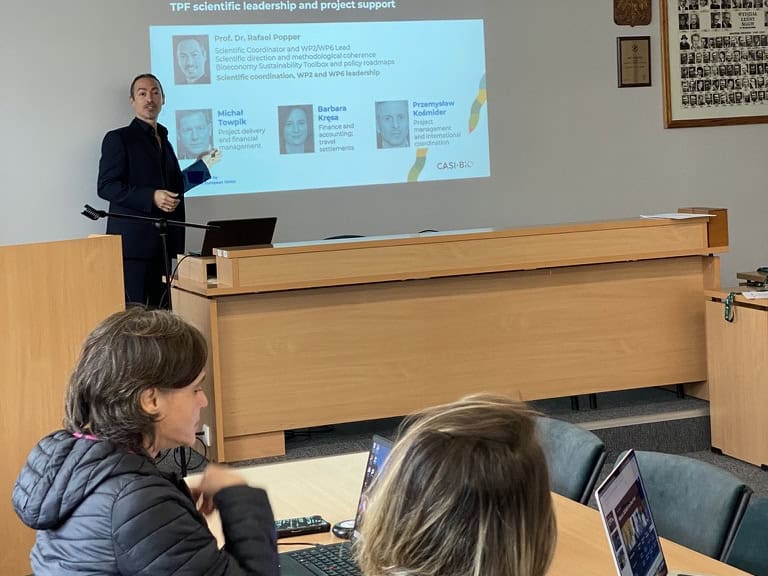


From 26 to 30 October 2026, Warsaw University of Life Sciences (SGGW) hosted the kick-off meeting of CASI-BIO, a Horizon Europe project bringing together 15 partners to advance sustainable and inclusive bioeconomy transitions. The five-day event marked the beginning of a collaborative effort to connect scientific knowledge, regional innovation and stakeholder engagement across 13 Living Labs.
The meeting brought the international consortium together to establish a common vision, discuss the project’s scientific and organisational framework, launch CASI-BIO publicly and develop a coordinated approach to its first year of implementation.
The TECHNOLOGY PARTNERS Foundation participates in CASI-BIO as the project’s Scientific Coordinator, working alongside ARC Fund (Bulgaria), the Project Coordinator, and the wider consortium.
Building a Shared Vision for CASI-BIO
The opening day, held under the theme ONE CASI-BIO, focused on bringing the consortium together and establishing a common understanding of the project’s objectives.
Representatives of the 15 partner organisations introduced their teams, expertise and expected contributions, highlighting the diversity of scientific, technological and regional perspectives within CASI-BIO.
Beyond formal introductions, the discussions explored shared ambitions, potential challenges and opportunities for collaboration. This initial exchange provided a foundation for connecting the partners’ capabilities with the project’s broader mission of supporting sustainable bioeconomy transitions.
The second day, BUILD the CASI-BIO Engine, moved towards the practical organisation of research and implementation activities.
Partners examined the relationships between the project’s eight work packages, discussed the requirements for implementing the 13 Living Labs and reviewed existing methods, tools and resources that could contribute to the CASI-BIO toolbox.
Particular attention was given to connecting scientific methodologies with regional needs and establishing a coherent framework for collaboration across the consortium.
CASI-BIO Officially Launched: Connecting Sustainability Principles with Practice
A major milestone came on 28 October, when CASI-BIO was officially presented to a wider audience during a public event at Warsaw University of Life Sciences.
Under the theme CASI-BIO in Europe and the World – Turning Sustainability Principles into Action, the event brought the project into a broader discussion on the future of the bioeconomy and the challenges of making sustainability principles applicable in practice.
The programme explored the relationship between scientific evidence, public policy, industrial innovation and societal needs. It also introduced the project’s network of 13 Living Labs as a framework for addressing sustainability challenges in different regional and socio-economic contexts.
The discussions highlighted the importance of interdisciplinary cooperation and meaningful stakeholder participation in developing solutions that respond to environmental, economic and social priorities.
Launching the Polish Living Lab: Forest-Based Bioeconomy
The afternoon of 28 October was dedicated to the launch of the Polish CASI-BIO Living Lab, focusing on forest-based bioeconomy and the cascading use of biological resources.
Hosted by SGGW, the workshop brought together local stakeholders and consortium representatives to explore practical challenges and opportunities associated with sustainable forest-based value chains.
Working across five thematic areas, participants examined stakeholder perspectives, existing knowledge, potential barriers and opportunities, as well as gaps requiring further investigation.
The workshop formed part of the project’s initial governance and scoping activities. Its purpose was not to deliver final solutions, but to establish a foundation for continued cooperation, evidence gathering and stakeholder engagement.
For the wider consortium, the Polish Living Lab also provided an opportunity to examine how the CASI-BIO methodology could be applied and adapted to different regional conditions.
TECHNOLOGY PARTNERS contributed to the methodological approach, helping connect the local stakeholder discussions with the project’s wider scientific framework.
From Scientific Planning to a Coordinated Roadmap
The final two days concentrated on turning the consortium’s shared vision into an implementation framework.
On 29 October, partners worked in four thematic Task Forces addressing complementary aspects of the project:
- DESIGN–DEPLOY: scientific methods, toolbox development and Living Lab implementation.
- EVIDENCE: sustainability assessment, evidence generation and knowledge management.
- STEWARD: governance, ethics and responsible project implementation.
- BRIDGE: technical integration, interoperability and connections between project activities.
The Task Forces focused on priorities, responsibilities, dependencies and milestones for the first 12 months of CASI-BIO.
On 30 October, the consortium brought these discussions together, reviewing the proposed roadmaps and identifying opportunities to improve coordination between the eight work packages.
This process provided a common basis for subsequent implementation, with particular attention to the connections between scientific methods, regional activities, sustainability assessment and knowledge sharing.
TECHNOLOGY PARTNERS as Scientific Coordinator
As the Scientific Coordinator of CASI-BIO, the TECHNOLOGY PARTNERS Foundation plays an important role in supporting the scientific coherence and methodological integration of the project.
Its contribution focuses on connecting scientific approaches with the practical needs of the Living Labs, facilitating cooperation between research activities and supporting the development of a consistent framework for knowledge generation and application.
The Warsaw kick-off meeting represented an important first step in this process, creating opportunities for collaboration across disciplines, organisations and regions.
With 15 partners and 13 Living Labs, CASI-BIO now moves from initial planning towards implementation, aiming to transform sustainability principles into practical approaches supporting bioeconomy transitions.

Views and opinions expressed are however those of the author(s) only and do not necessarily reflect those of the European Union or the European Commission. Neither the European Union nor the European Commission can be held responsible for them.


